The Land – A District at the End of the Road
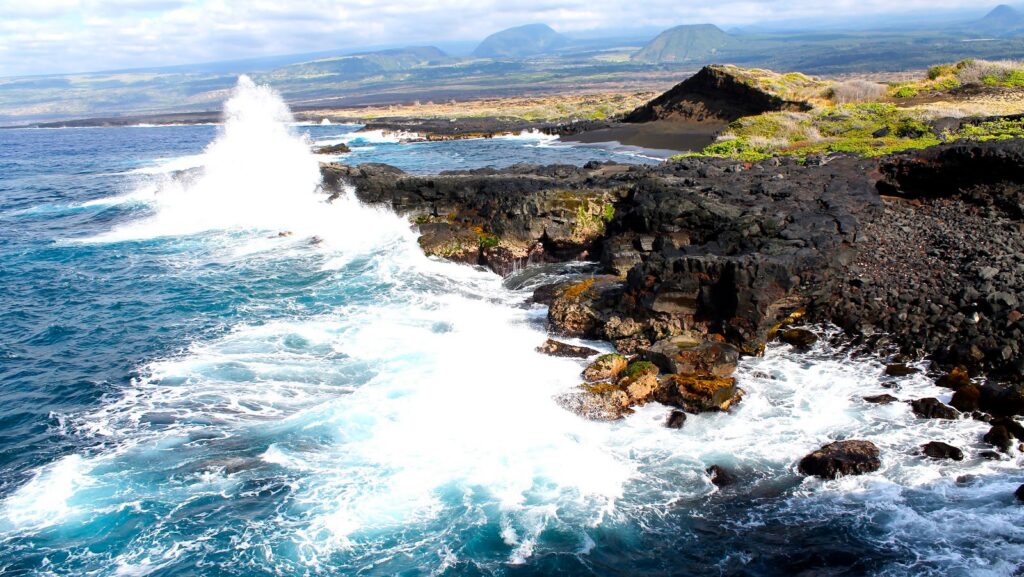
Kaʻū sits at the bottom of the island of Hawaiʻi, running from the summit region of an active volcano down to the sea at Ka Lae, South Point, the southernmost place in all fifty states. It is the largest district on the island by land and one of the smallest by population. The towns are few and far between: Pāhala, Nāʻālehu, Waiʻōhinu, Ocean View, the old plantation camps. Between them: cattle land, lava flows, macadamia and coffee, and miles of open coast where the cliffs drop straight into deep water.
To live in Kaʻū is to live at the end of the road. The nearest hospital with specialty care is hours away in the island’s two primary “cities,” Hilo or Kona. When the weather (or Kilauea volcano) closes the island’s single highway — and it does — Kaʻū is on its own. This is not a hardship the people of Kaʻū complain about. It is simply the truth of the place, and it has shaped every generation that has lived here.
Hawaiʻi is made up of eight main islands. Kaʻū is the southern district of Hawaiʻi Island — the largest of them — running from the summit of the volcano down to Ka Lae, the southernmost point in the United States.
The eight main Hawaiian Islands. Hawaiʻi Island — “the Big Island” — anchors the chain to the southeast.
Kaʻū (shaded) spans the island’s southern slopes. Tap a place to learn more.
The Living Earth – You Can Feel the Land Breathing
In Kaʻū, the earth is never still. You smell sulfur on the wind when the volcano is active, a sharp mineral edge that locals know by heart. At night the southern sky can glow faintly orange where lava meets the dark. The ground itself moves — small earthquakes are so common that children grow up knowing the difference between a tremor that passes and one that makes you stand in a doorway.
The trade winds carry salt up from the cliffs at South Point, where the surf never rests and the current runs so hard it has pulled fishermen out to sea for a thousand years. In winter the rains come in sheets, turning dry gulches into brown floodwater in minutes. In hurricane season the whole community watches the same storm tracks, because everyone knows the highway is a single thread, and a downed tree or a washed-out culvert can cut Kaʻū off entirely.
This is what it means to live with the land instead of on top of it. The people of Kaʻū do not imagine they have tamed this place. They have learned it. Mālama ʻāina — to care for the land — is not a bumper sticker here. It is the daily arithmetic of survival.
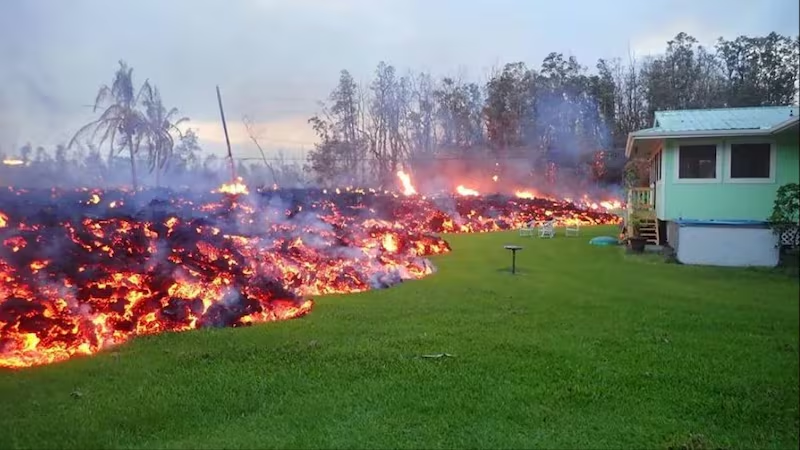
Volcano
Kaʻū lies on the active southern slopes of the island. Eruptions, vog, and the constant possibility of new lava are part of the landscape, not a rare event.
Hurricanes
Hurricane season puts the entire district on alert. A single highway means a single point of failure when a storm makes landfall.
Earthquakes
One of the most seismically active regions in the country. Tremors are routine; major quakes have damaged homes, roads, and the district’s only hospital.
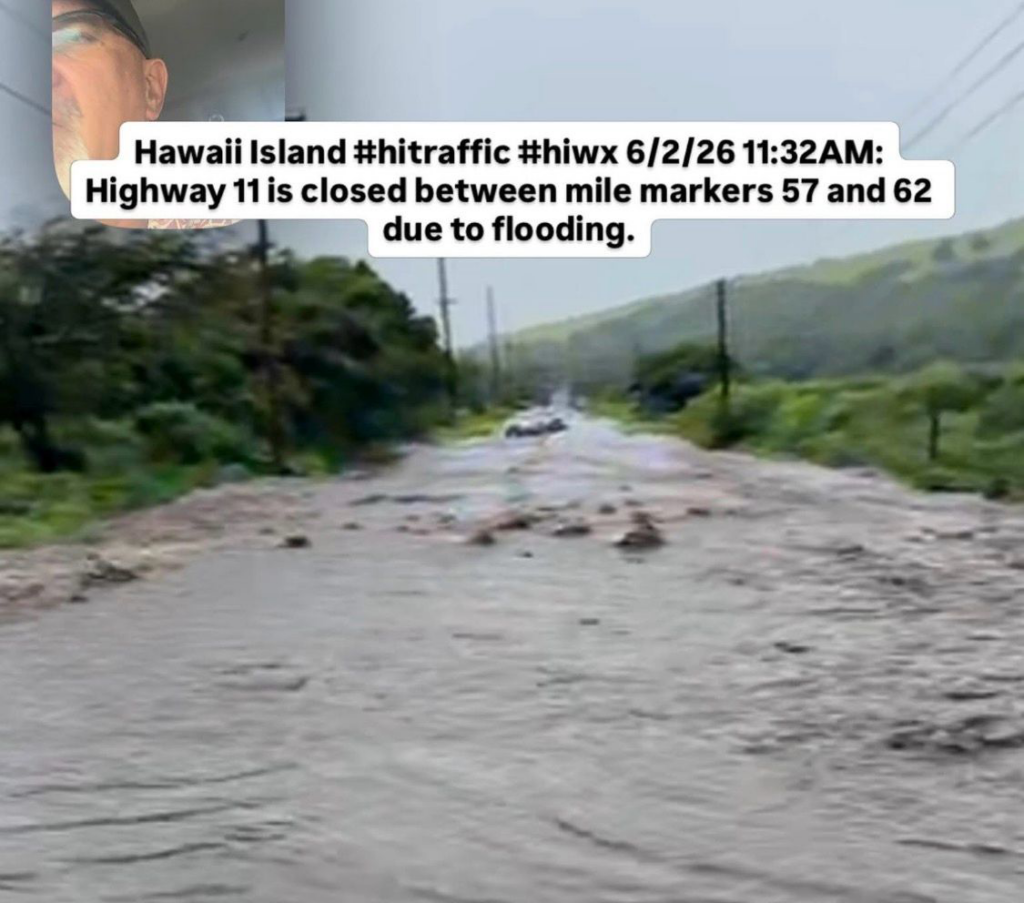
Flash Floods
Sudden, heavy rain turns dry gulches into torrents. Flash flooding closes roads and isolates communities with little warning.
The People — The Numbers Tell Part of the Story
Kaʻū is one of the most rural communities in Hawaiʻi, and one of the poorest. Household incomes sit below the state median. Poverty rates across the district’s towns run well above the Hawaiʻi average — and in a state with one of the highest costs of living in the nation, those numbers cut deeper than they would almost anywhere else. The public schools serve a small, dispersed population across enormous distances. And the healthcare system is stretched to its limit.
922 mi²
The largest district on Hawaiʻi island — served by a single critical-access hospital and one highway. Note: the entire island of Oahu, home to Waikiki and Pearl Harbor, is 597 square miles. The island of Oahu easily fits within the Ka’u district.
1
The number of inpatient hospitals in the entire district: Kaʻū Hospital in Pāhala, a federally designated critical-access facility.
0
Dialysis clinics in Kaʻū. The nearest treatment is in Hilo — hours of driving, three days a week, for those who need it to live.
One of the Highest
Concentration of Native Hawaiians of any community in the state — Kaʻū’s roots run a thousand years deep.
Among the Highest
Concentration of military veterans per capita in Hawaiʻi. Service is woven into the fabric of this community.
10+
Generations of my Native Hawaiian ancestors who have lived, fished, farmed, and buried their dead in Kaʻū. Including my father.
Poverty and demographic figures vary by town and census year across Pāhala, Nāʻālehu, Waiʻōhinu, and Ocean View. Healthcare facility counts reflect the district’s single critical-access hospital and the absence of any local dialysis center. Exact figures available on request and updated against current U.S. Census and Hawaiʻi Health Systems data.
The Healthcare Gap – When the Treatment That Keeps You Alive Is Hours Away
Kaʻū Hospital in Pāhala has served the district since 1971, when it replaced the last of the old plantation hospitals. It is a critical-access hospital — the federal designation for small facilities providing essential emergency and acute care in remote areas. It is one of the largest employers in Kaʻū and the only inpatient medical facility for the entire 922-square-mile district. The people who work there are heroes. But a critical-access hospital cannot do everything.
There is no dialysis clinic anywhere in Kaʻū. For a kupuna diagnosed with kidney failure, that single fact reorders an entire life. The nearest dialysis is in Hilo — a drive of well over an hour each way from the towns of Kaʻū, three days a week, for as long as they live. For an elder, for a family with one car, for a person already weakened by illness, that distance is not an inconvenience. It is a wall. Too often, the choice becomes leaving the land your family has held for ten generations, or going without the care that keeps you alive.
This is the gap at the center of everything Mālama Kaʻū Foundation is working to close.
We are not a community that has been waiting to be rescued. We are a community that has been waiting for the tools to rescue ourselves. – The People of Kaʻū
The Resilience – Warrior Culture Is Not a Metaphor Here
The same land that isolates Kaʻū has forged its people. When you grow up at the end of the road, on the slopes of a living volcano, between the hurricane and the flood, you do not wait for help that may not arrive. You learn to fish, to farm, to fix what breaks, to take care of your neighbor because your neighbor is taking care of you. Self-reliance in Kaʻū is not an ideology. It is a habit passed down through generations.
It is no accident that Kaʻū sends so many of its sons and daughters into uniform. This is a community with one of the highest concentrations of military veterans in the state — a warrior culture that runs from the ancient koa, the warriors of old Hawaiʻi, straight through to the men and women of Kaʻū serving today in every branch of the U.S. Armed Forces. The discipline, the loyalty, the willingness to endure hardship for the people beside you — these were Kaʻū values long before they were military ones. The uniform simply recognized what the land had already built.
Kaʻū has survived plantation booms and busts, the closing of the sugar mills, the erasure of its people from the census rolls, eruption and earthquake and storm. It is still here. The people are still here. That is not luck. That is kūpaʻa — to stand firm.
The Traditions – The Old Ways Are Still the Way
The culture of Kaʻū is not preserved behind glass in a museum. It is practiced, daily, in the way people live, eat, fish, gather, and care for one another. These are a few of the traditions woven into the fabric of the community.
Mālama ʻāina – Care for the Land
The reciprocal relationship between people and place. The land feeds you; you protect the land. In Kaʻū, this governs how families fish, where they plant, and what they take and leave behind.
Lawaiʻa – Fishing & the Ocean
Generations of shoreline and deep-water fishing knowledge — reading the tides, the moon, the currents off South Point — passed from kūpuna to grandchildren. Subsistence fishing still feeds families across the district.
Mahiʻai – Farming & Subsistence
Kalo (taro), ʻuala (sweet potato), and the food gardens that have sustained Kaʻū families for centuries — alongside the coffee and macadamia that grew from the plantation era. Self-provision over dependence.
ʻOhana — Family & Kinship
In Kaʻū, ʻohana extends far past blood. Neighbors are family. When a storm hits or a family struggles, the community closes ranks. No one faces the land alone.
ʻŌlelo & Moʻolelo – Language & Story
The Hawaiian language and the oral histories that carry the names of places, the deeds of ancestors, and the lessons of the land — including the moʻolelo tied to South Point, where the first voyagers came ashore.
The People of Kaʻū
Kaʻū is an independent people. We have endured isolation, disaster, and neglect, and we are still standing. Not because anyone saved us. Because we learned long ago to save ourselves.
Long before sugar cane arrived in the 1800s, Kaʻū was known throughout the Hawaiian Islands for its warriors. Not just in battle, but in spirit. Kaʻū carried the highest concentration of Native Hawaiian warriors in the islands, fierce protectors of their land against any force, foreign or domestic, that sought to exploit or compromise what this district stood for. That was never purely a military identity. It was a deep, principled refusal to surrender Kaʻū’s land, culture, and way of life to people who did not respect them.
That spirit did not disappear when the warriors put down their weapons. It walked into the cane fields.
For nearly a century, Kaʻū families labored side by side in the sugar industry, bringing the same discipline, endurance, and pride of ownership they always had. Isolated on the southern end of the Big Island, far from the centers of power, far from the hospitals and the highways and the institutions that the rest of the state takes for granted, we built our lives with our own hands. The land shaped us. The ocean tested us. The ʻohana held us together.
We have had enough of waiting on subsidies and programs designed by people who have never driven our highway or felt our ground shake. Kaʻū does not need to be saved. Kaʻū needs to be heard, respected, and left with the tools to do what we have always done.
Take care of our own.
ʻAʻohe hana nui ke alu ʻia. No task is too large when done together.