my Native Hawaiian Lineage
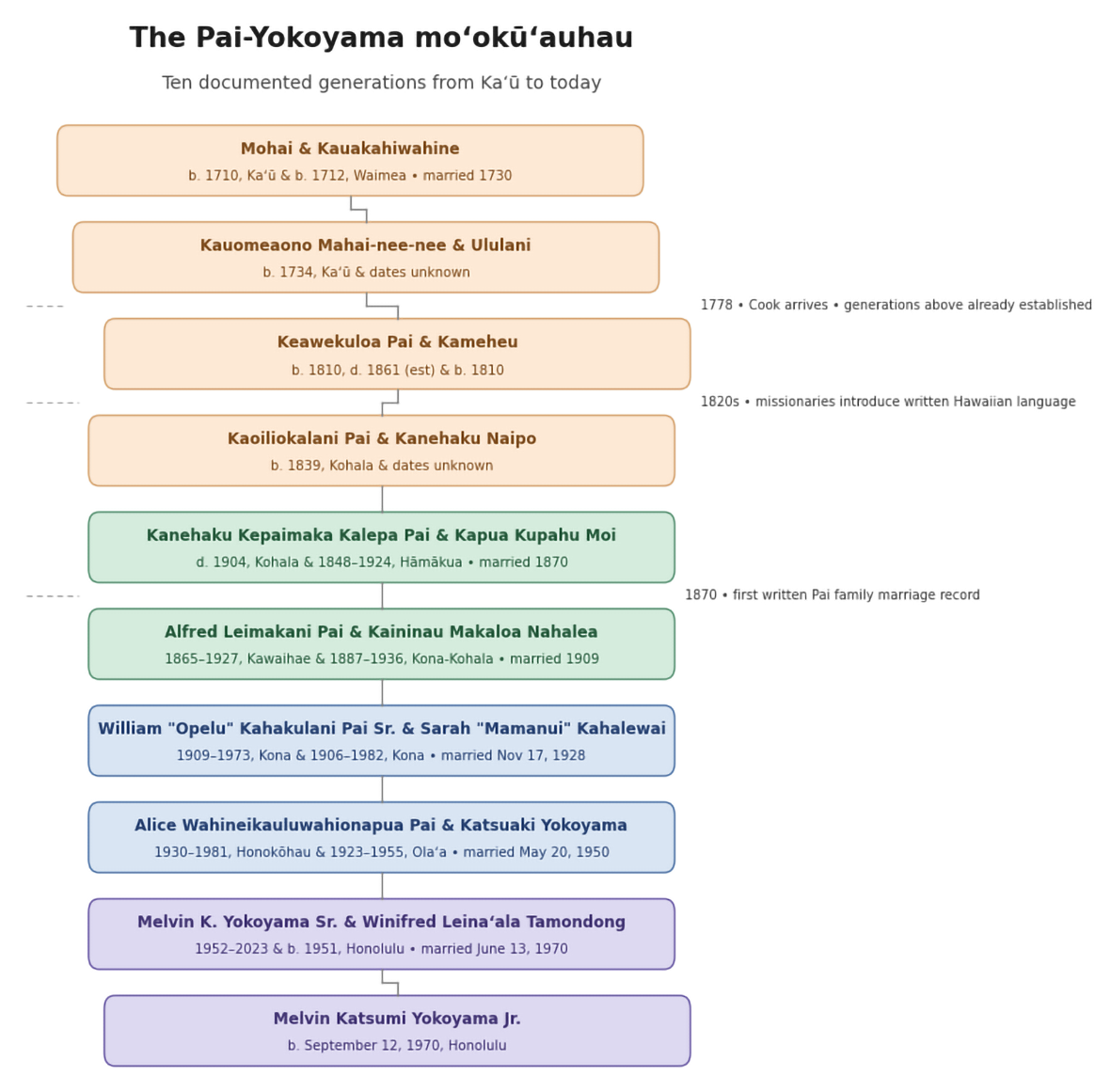
I am a (10) tenth-generation Native Hawaiian. The lineage below begins in Kaʻū in 1710 — sixty-eight (68) years before the first European, Captain Cook, sighted the Hawaiian Islands in 1778 — and runs unbroken to today. This is how I trace it. This is how my family has always traced it.
Authenicated by the Office of Hawaiian Affairs (OHA), the State of Hawaii’s organization responsible for Native Hawaiian ancestry verification.
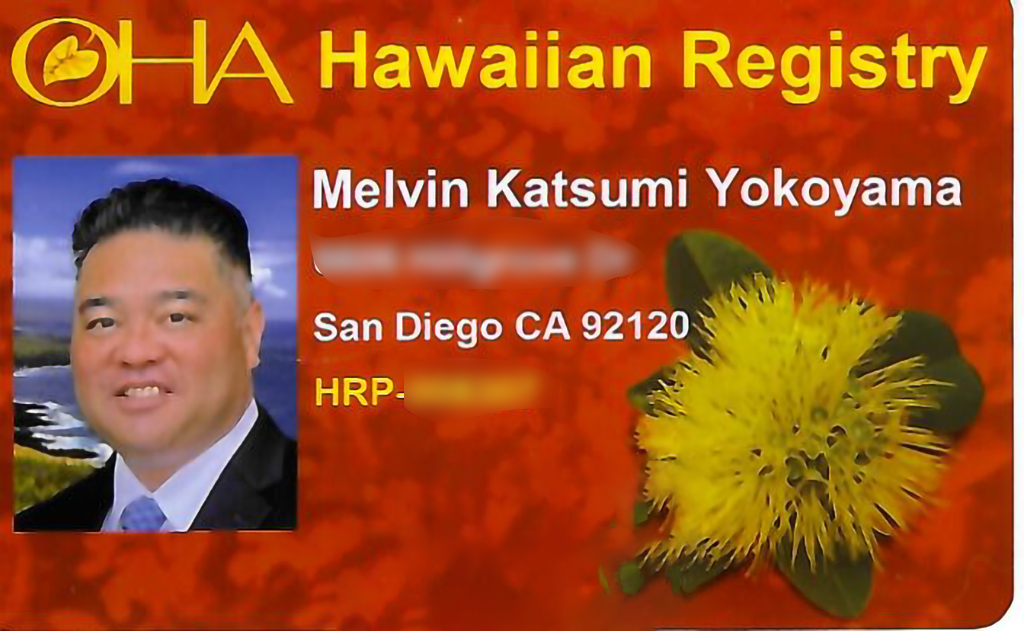
The Moʻokūʻauhau
There was no written Hawaiian language until the missionaries arrived in 1820 and began transcribing what they heard.
What we had instead was the Moʻokūʻauhau, a genealogical record passed down through generations by memory, chant, and recitation. Think of it as a living family tree, spoken aloud with the same precision a lawyer applies to a legal brief. Authenticated by the Office of Hawaiian Affairs (OHA) and validated against genealogical archives held in the Mormon library in Utah, our family’s Moʻokūʻauhau traces the Pai lineage back to Mohai in 1710.
The First Written Record, 1870
The first time any of it appeared in writing was a marriage license issued in Waimea (Big Island) on December 1, 1870. Palapala Ae e Mare, Permission to Marry, registered in South Kohala. It joined K. Pai of Kawaihae and Mrs. Kapua of Hamakua. That license did not create our history. It simply made it legible to a western bureacracy that would, less than a decade later, take part in overthrowing the very kingdom that issued it.
The chain ran on regardless. All the way to my father. All the way to my son John, the 11th generation of our Native Hawaiian bloodline.
the Burden of Proof
The Hawaiian language was spoken, not written, until Protestant missionaries from Boston developed the first Hawaiian-language Bible in 1839. Sixty-one (61) years after Captain Cook arrived. 61 years after the world they would document had already been living, breathing, and remembering itself for centuries.
Today, federal regulations require written documentation of pre-1778 ancestry to establish that someone is Native Hawaiian.
Read that again.
The genealogies were chanted. The lineages were memorized and passed, generation to generation, with a precision that shamed what paper could hold. Our ancestors did not write down who they were because they did not need to. They knew. Their children knew.
Requiring a Western recording standard on a tradition that was never Western is not a technicality. It is a mechanism that produces a predictable result: Native Hawaiians, disqualified on their own land, by rules written in a language their grandparents were forbidden to speak.
The Federal Definition of a “Native Hawaiian”
The U.S. Small Business Administration (SBA), under 13 C.F.R. § 124.3, defines “Native Hawaiian” as follows:
Native Hawaiian means any individual whose ancestors were natives, prior to 1778, of the area which now comprises the State of Hawaii.
By this definition, I am Native Hawaiian. The lineage on this page documents how. Mohai, born in Kaʻū in 1710, was a native of the area that now constitutes the State of Hawaiʻi before Captain James Cook “discovered” our islands on January 18, 1778.
Native hawaiian organization (NHO)
Native Hawaiian Organization (NHO) means any community service organization serving Native Hawaiians in the State of Hawaii which is a not-for-profit organization chartered by the State of Hawaii, is controlled by Native Hawaiians, and whose business activities will principally benefit such Native Hawaiians.
The integrity of the NHO program works only when the “Native Hawaiian” NHO board member’s lineage can actually be traced to pre-1778.
$100 Million Sole Source Contracts
Most people do not know this. A qualified NHO-owned small business can be awarded a US federal contract — a single contract — worth up to $100 million dollars. No competitive bidding. No head-to-head competition. Just a direct award from a federal agency to an NHO-owned firm.
That is not a loophole. That is Congress delivering on a promise to one of the most geographically isolated and economically underserved indigenous communities in America.
But to get there, the dots have to connect.
Your organization has to qualify as an NHO — which means Native Hawaiians hold the majority of board seats. That NHO has to own and control an “SBA 8(a)-certified small business.” And that 8(a) small business must be capable of fulfilling the contract requirements.
Every link in that chain matters. Break one and the whole thing collapses.
That is why the fight over who qualifies as Native Hawaiian is not an academic debate. It is a $100 million question. It determines who controls the board. The board determines whether the organization qualifies. The organization determines whether it’s able to receive $100M sole source federal government contracts.