AVAILABLE IN SPRING 2027
A story of ka’u, family, service, and legacy
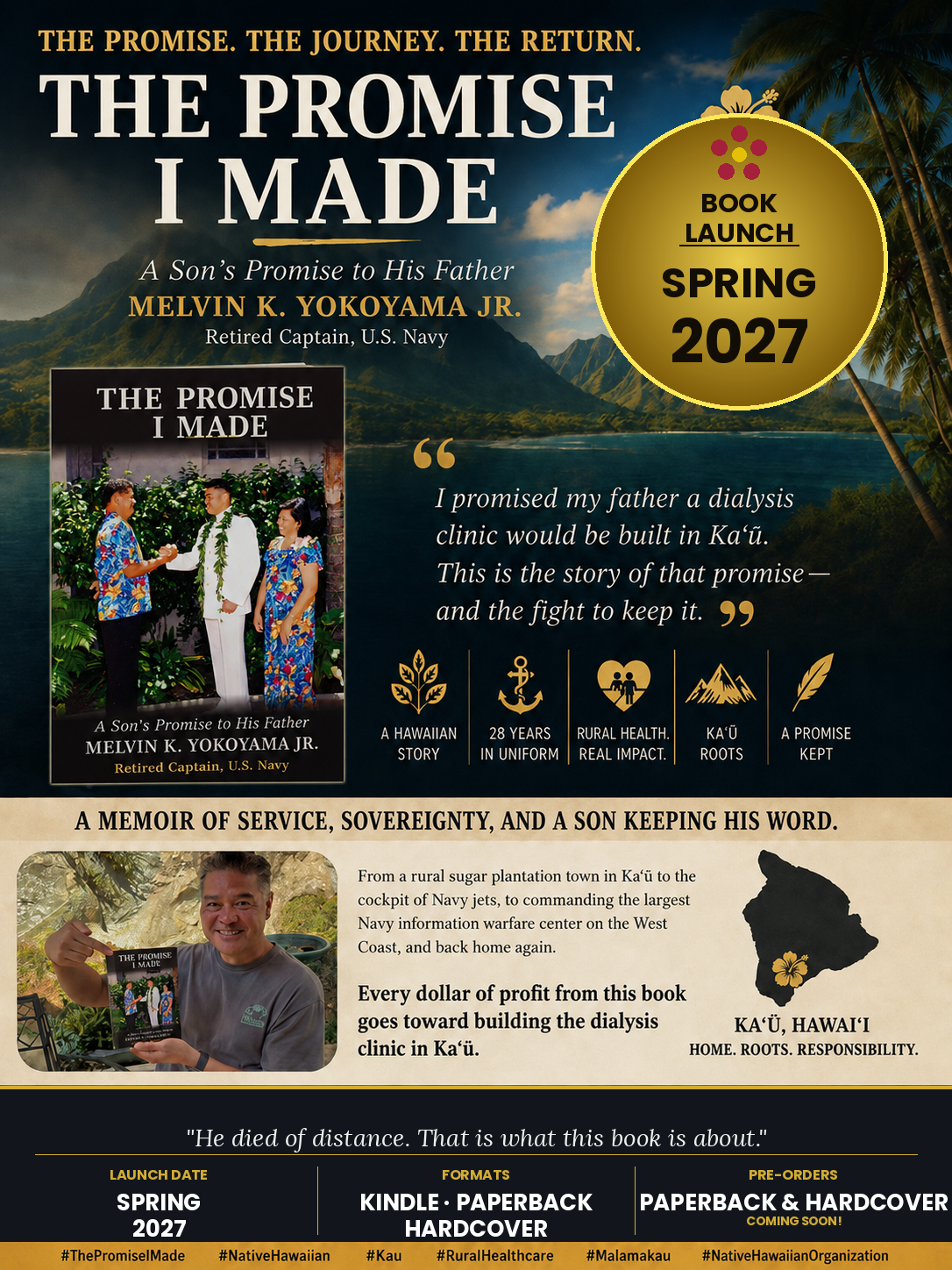
The Book
In 1988, a seventeen-year-old boy from Pāhala, a sugar plantation town on the southern shore of Hawaiʻi island, boarded a plane to San Diego and reported to Navy boot camp the next morning. It was his first time on the U.S. mainland. He would not return home for 32 years.
The Promise I Made is the memoir of those 32 years and what came after.
It is the story of a 10th generation Native Hawaiian who flew combat missions over Bosnia, Iraq and Afghanistan, and logged a thousand hours of strategic reconnaissance against China, Russia, and North Korea, qualified as Officer of the Deck aboard USS Ronald Reagan (CVN 76) on her maiden deployment to the Persian Gulf and Western Pacific, advised the Iraqi Minister of Defense in Baghdad during the fight against ISIS and the liberation of Mosul, and retired in 2020 as the Commanding Officer of the Navy’s largest research and development center on the West Coast.
It is also the story of a son who made a promise to his dying father — that a dialysis clinic would be built in Kaʻū so kūpuna would no longer have to leave the ʻāina to live. And of the work that promise became.
This book is for anyone who has ever served a country whose history is complicated, loved a place that asked everything of them, or carried a promise heavier than they thought they could bear.
What you will find inside
A military memoir — combat flights over Iraq, reconnaissance missions conducted against three nuclear powers, the maiden deployment of the USS Ronald Reagan, command at sea, command on shore, and a year in Baghdad advising a foreign defense minister during the height of ISIS invasion in Iraq.
A leadership memoir — what 28 years in uniform taught me about leading people when the cost of being wrong is measured in lives. No theory. No LinkedIn aphorisms. The lessons that survived contact with reality.
A Native Hawaiian history — from the Polynesian voyagers who landed at Ka Lae (South Point) more than a thousand years ago, to the 1893 overthrow, to the 1993 Apology Resolution, to what it means to be the tenth generation walking the same shoreline.
An American identity story — what it means to wear the uniform of a country that overthrew your ancestor’s kingdom. To serve, to lead, to bleed for the flag…and still carry the older flag in your heart.
The promise — the dialysis clinic in Kaʻū, the nonprofit foundation built to make it real, and the federal program – designed for Native Hawaiians to become econonically independent – now under attack by the very government I served.
A Passage from the Book
My dad had diabetes. Like too many Native Hawaiians, like too many people in Kaʻū, he lived with a disease that required serious, consistent medical intervention to survive. In his case, dialysis. Three times a week, every week, without interruption – because that is what dialysis requires. Not when it is convenient. Not when the roads are clear. Three times a week, or you die.
There is no dialysis clinic in Kaʻū.
Let that sit for a moment. Kaʻū is the largest district in the State of Hawaiʻi. It has one of the highest concentrations of Native Hawaiian residents in the state. It has generations of veterans who served this country and came home to live out their lives on this land. And it does not have a single dialysis clinic.
So my dad drove himself to Hilo. Three times a week. An hour each way at minimum, longer when the flash floods came, or when volcanic activity made the only two-lane highway impassable, which in Kaʻū is not a hypothetical. It is just Tuesday.
– from The Promise I Made
About the Author
Melvin K. Yokoyama Jr. is a tenth-generation Native Hawaiian, born in Honolulu and raised in Pāhala. He served twenty-eight years in the U.S. Navy as a Naval Officer, retiring in September 2020 as Commanding Officer of the Navy’s largest Information Warfare Center on the West coast, NIWC Pacific. He is the founder of Akamai Intelligence LLC and Chairman of the Mālama Kaʻū Foundation. The Promise I Made is his first book.
Be The First To Know
The Promise I Made will be available for purchase in the Spring of 2027. To receive notice when hardcopy and paperback versions of book is released — and to be invited to early reader and launch events — join the list below.