The Fight For Kaʻū
Dialysis: The Fast Food Business of Healthcare
Who profits when a dying man cannot find a chair.
In Hawaiʻi, the machines that keep kidney-failure patients alive are controlled by a very small number of companies — and the largest of them does not answer to Honolulu or to Washington. It answers to Bad Homburg, Germany.
That company is Fresenius Medical Care, the biggest dialysis corporation on earth. In 2024 it reported revenue of roughly €19.3 billion — about $21 billion — and treated close to 300,000 patients across some 3,675 clinics worldwide. It holds an estimated 38% of the entire U.S. dialysis market. In Hawaiʻi it operates under the name Liberty Dialysis, the network Fresenius purchased in 2012.
Fresenius Medical Care
- Headquarters: Bad Homburg, Germany
- 2024 revenue: ~€19.3 billion (about $21 billion)
- Reach: ~300,000 patients • ~3,675 clinics worldwide
- U.S. dialysis market share: ~38%
- In Hawaiʻi: operates as Liberty Dialysis (acquired 2012)
Paid for by you
Here is what makes it extraordinary: nearly every dollar of that business is public money. Since 1973, Medicare has covered almost anyone with kidney failure — regardless of age — one of the only conditions in America that qualifies a person for Medicare automatically. Today, more than 90% of Americans on dialysis are carried by Medicare, with Medicaid covering many of the rest. In Hawaiʻi — where so many patients are kūpuna and working families — the overwhelming majority are on Medicare or Medicaid.
So follow the money. It begins in a U.S. taxpayer’s paycheck. It pays for a treatment in a clinic in Hilo or Honolulu. And then the profit boards a plane — to Germany. Public dollars in; private, foreign profit out. Almost none of it stays in Hawaiʻi, let alone in the United States.
Public dollars in. Foreign profit out.
Dialysis in America is overwhelmingly financed by Medicare and Medicaid — U.S. taxpayers. The care is delivered here in Hawaiʻi. But the revenue and the profit flow to a corporation an ocean and a continent away.
The fast-food model
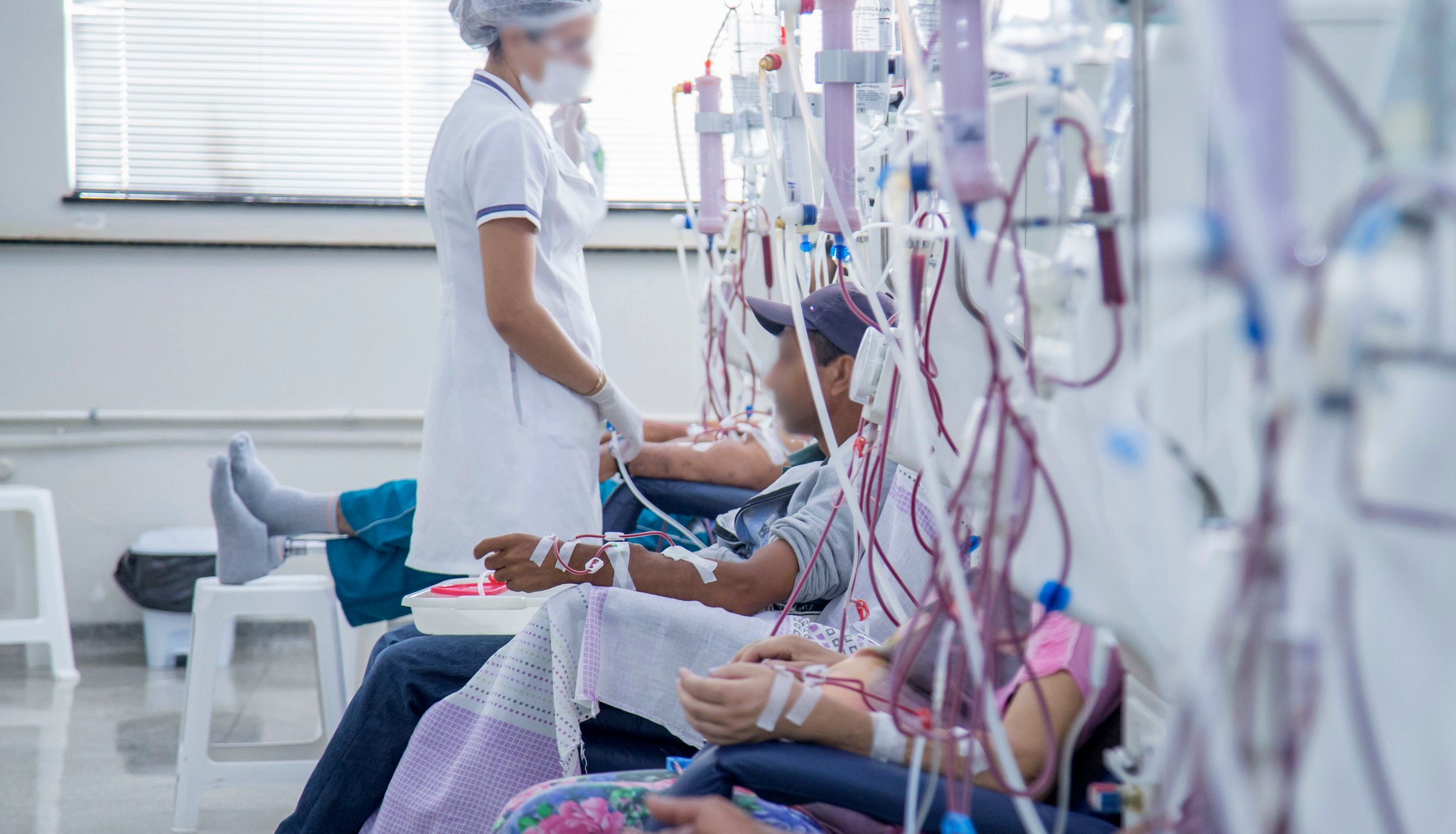
To understand the incentive, picture a fast-food franchise. Every dialysis chair is a seat in the restaurant. Every patient in that chair — three times a week, for hours at a time — is a paying customer, and the government reimburses the company for each and every visit.
A business like that does not grow by curing people. You cannot cure your way to higher revenue. It grows by filling more chairs, in more clinics, for more sessions — more seats, more customers, more billing. That is the incentive baked into the model: not fewer patients, but more. And, above all, no new competition to split the tab.
The gatekeeper: Certificate of Need
So how do the chairs stay full and the rivals stay out? In Hawaiʻi, before anyone can open a new dialysis center, the state requires a Certificate of Need (CON) — government permission certifying that a new facility is even warranted. On paper, it is about orderly planning. In practice, it is a moat.
The review takes 90 days at a minimum, and sometimes drags on for years — and the companies already holding licenses get to weigh in against the newcomers who would compete with them. Hawaiʻi is one of only a handful of Western states still clinging to these rules. The result on the ground: patients driving across islands, waiting weeks for an opening, some pushed into 11 p.m. appointments — while incumbents face almost no new rivals.
The permission slip that keeps the doors closed
- A state permit required before opening a new dialysis clinic in Hawaiʻi
- Adds 90+ days — and often stretches into years
- Lets existing providers formally oppose would-be competitors
- Net effect: less competition, longer waits, fuller chairs
When someone tried to open the doors
In 2021, then-Representative Ryan Yamane introduced House Bill 224 — a measure to exempt dialysis centers from the Certificate of Need requirement and let the market open. It would have made it easier to build new clinics closer to the patients who need them — including in rural districts like Kaʻū.
The bill advanced all the way to a final vote. And then, in the last hours of conference, it was quietly “recommitted” — legislative language for killed. The dialysis industry, including Fresenius and U.S. Renal Care, had opposed it.
The indictment
In July 2026, a state grand jury indicted five people in a sweeping Hawaiʻi bribery case. Among them: former Representative Ryan Yamane and businessman-lobbyist Tobias “Tobi” Solidum — who lobbied for Liberty Dialysis, the Fresenius operation in Hawaiʻi, and for the National Kidney Foundation of Hawaii.
Prosecutors allege that Solidum paid Yamane cash and checks between 2020 and 2022 to influence legislation. According to the charging documents, after the dialysis CON bill died, Solidum texted Yamane:
“As long as its dead we are ok. Thanks for all your efforts.”— text message cited in the indictment
Yamane has pleaded not guilty. Solidum did not appear in court; prosecutors believe he has fled to the Philippines. Their trial is set for September 28, 2026.
What prosecutors say happened
- Five defendants indicted by a state grand jury, July 2026
- Among them: former Rep. Ryan Yamane and dialysis lobbyist Tobi Solidum
- Allegation: cash and checks, 2020–2022, to influence legislation
- The dialysis CON exemption bill was killed in conference
- Trial: September 28, 2026
- Solidum: believed to be a fugitive in the Philippines
What it cost my father
This is not an abstraction to me. My father needed dialysis in Kaʻū — the same rural district where our family has lived for ten generations. He faced the wall every Kaʻū patient faces: the nearest chairs are far, the road is long, and the state’s Certificate of Need process stood between our community and a clinic of its own.
Had House Bill 224 passed in 2022 — had the doors been opened instead of quietly shut — I believe my father would still be here.
He died on December 8, 2023.
The promise I made at his bedside is the reason this website exists: a dialysis center in Kaʻū, in his memory, so that no other family ever has to measure a father’s life in miles to the nearest chair.
I will not give up. — Mel
Sources
- Fresenius Medical Care — full-year 2024 results (revenue, patients, clinics). freseniusmedicalcare.com
- Fresenius Medical Care — company overview: German headquarters, ~38% U.S. market share, 2012 acquisition of Liberty Dialysis. en.wikipedia.org
- Honolulu Civil Beat — “State Rules Make It Harder To Open Dialysis Centers In Hawaii” (Certificate of Need, HB224, Rep. Yamane, Fresenius/Liberty). civilbeat.org
- Hawaiʻi State Department of Health — Certificate of Need program (SHPDA). health.hawaii.gov
- Hawaiʻi State Legislature — House Bill 224 (2021). capitol.hawaii.gov
- Congressional Research Service — Medicare Coverage of End-Stage Renal Disease (ESRD), Report R45290. congress.gov
- Medicare End-Stage Renal Disease Program — coverage since 1973; 90%+ of U.S. kidney-failure patients covered. en.wikipedia.org
- Honolulu Star-Advertiser — “Lt. Gov. Sylvia Luke, 4 others charged in bribery conspiracy” (July 25, 2026). staradvertiser.com
- Honolulu Star-Advertiser — “Who are the 5 defendants in Hawaii’s political bribery case?” (July 26, 2026). staradvertiser.com
- Honolulu Civil Beat — “Culture Of Corruption? Records Link Arrested Lawmaker To Lobbyist” (Yamane, Solidum, Liberty Dialysis, HB224 text message). civilbeat.org
- Honolulu Civil Beat — “Hawaiʻi Bribery Scandal: Defendants Plead Not Guilty” (trial date Sept. 28, 2026; Solidum believed in the Philippines). civilbeat.org
- Hawaii News Now — “Luke among 5 indicted by grand jury following massive bribery probe” (July 25, 2026). hawaiinewsnow.com